
A star is a giant glowing ball of hot gas in space that can be seen in the night sky, though only a small percentage are visible to the naked eye.
Stars are born in patches of gas and dust floating in space, known as stellar nurseries. Gravity pulls the gas and dust closer together, forming clumps until they are large enough and collapse, releasing energy. As the temperature and pressure rise in these clumps, hydrogen atoms are squished together and form a new element, helium, through a process called nuclear fusion. It is this process that causes the star to shine.
After stars are formed, left over gas and dust swirl around the new star in a spinning disk, called a protoplanetary disk. As this material spins around, they bump into each other and clump up, similar to snowballs. These clumps keep growing, eventually forming a planet. Despite forming similar to stars, planets do not form large enough clumps to drive nuclear fusion. As a result, planets do not produce their own light, and instead reflect light from the sun.
Looking at the night sky, you might notice some "stars" twinkle while others don't. Starlight enters our atmosphere, and the light waves bend as they pass through pockets of air at different temperatures. This bending of light is called refraction, and since the light is coming from a single point, stars appear to twinkle. On the other hand, planets are much closer and instead appear as tiny discs in the sky. The light we get from planets is much larger, cancelling out the refraction.
With just the naked eye, ancient civilisations were able to observe and record the night sky, noting down the positions of stars, eclipses, and moon phases. Through this, they were able to make star maps, with the first recorded star map being made in 1000 BCE by the Assyro-Babylonians in Mesopotamia, in which is now present day southern Iraq. Ancient Greeks noticed that whilst most stars in the night sky moved east to west in a fixed position, there were some stray stars that would wander. Coming from the Greek word "planetes" meaning wanderer, these wandering stars were found to be planets that moved within their own orbit.
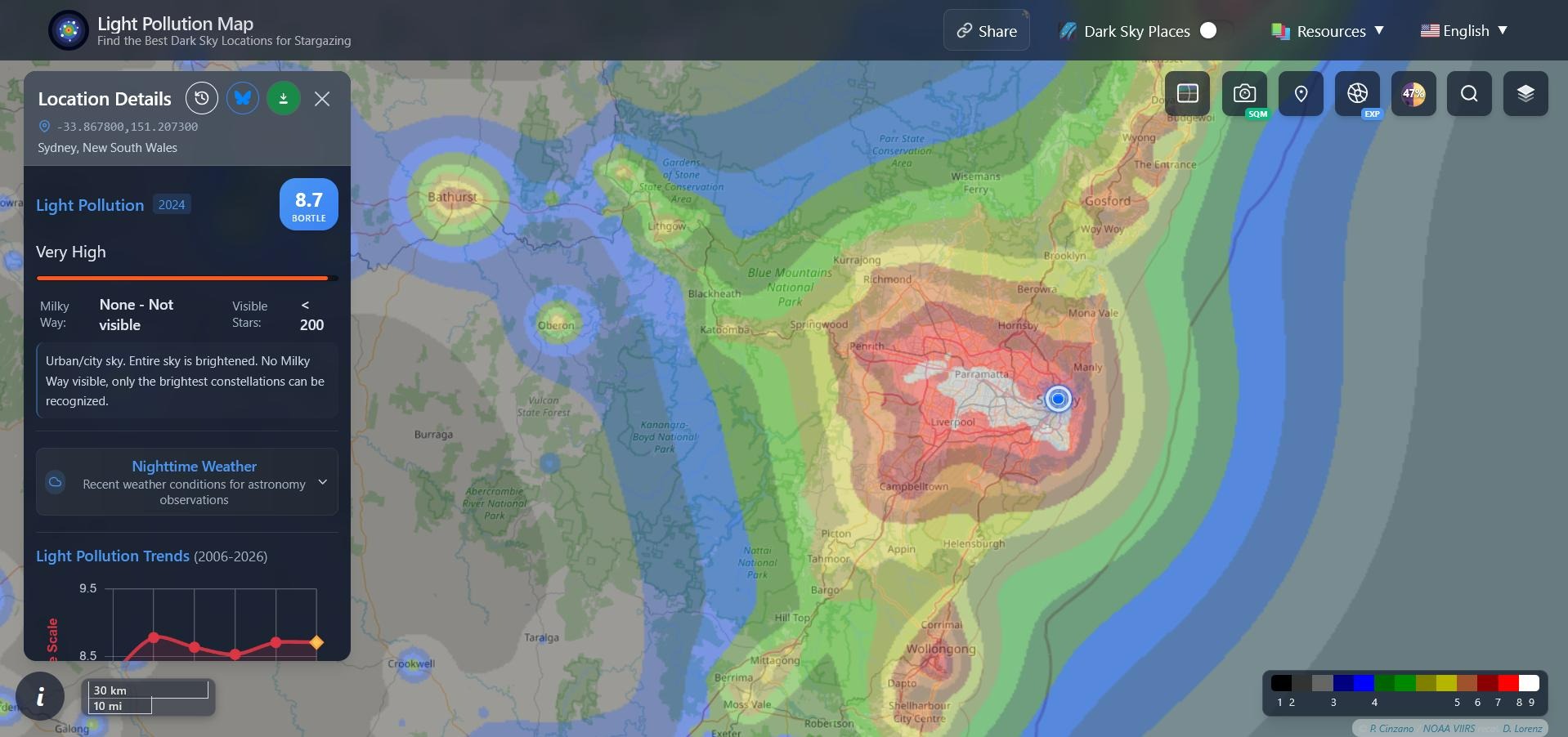
Created by John E. Bortle in 2001, most astronomers use the Bortle Scale to classify the level of light pollution in an area. The Bortle Scale is a 9 level numeric scale, with class 1 being classified as excellent dark sky viewing with no light interference, and class 9 referring to inner city sky viewing where light significantly reduces the number of objects seen. The scale allows astronomers and the general public to compare the darkness of observing sites, and quantify the extent of light pollution in an area.
Light pollution is the excessive use of artificial light, which projects up into the night sky and creates a sky glow, turning night into day. Mostly found over urban areas, nighttime use of cars, streetlamps, and other poorly designed lights brighten up the sky, affecting humans, plants, and animals. Light pollution drowns out light from celestial bodies such as galaxies, planets, and stars, and make it harder to see at night.
Light pollution affects humans, plants, and animals, by confusing our natural circadian rhythm. In humans, artificial light decreases melatonin production, which is the hormone that helps us sleep. Similarly, plants and animals also use natural light signals from the sun, moon, and stars to time their behaviours, which get disrupted with light pollution. Nocturnal animals with migration patterns are guided by moonlight, and get lost and confused. Light pollution also prevents nocturnal animals from feeding in lit areas, as they risk being eaten by predators. Other behaviours such as food availability, rest and activity, and reproduction, also get impacted.
To minimise light pollution, lights should only be turned on when necessary and only for a specific purpose. Adaptive light controls help manage the timing, intensity, and colour of the light, as lights that appear dim to humans may appear bright to wildlife. When using low intensity lighting outside, keeping it close to the ground minimises its effect. Only warm coloured bulbs should be used, as blue light found in LEDs (as well as LEDs in general) has been shown to reduce melatonin levels in humans, also impacting wildlife. In existing and future streetlamps, caps can not only improve the effectiveness of the lightbulb, but also minimise the effects of light pollution. Caps redirect the light to properly illuminate the ground, keeping it out of our eyes, and out of the night sky.
Want to find out how light polluted your area is? Check out this cool interactive map!